How to Rank in Norway: A Practical Guide for International Founders

Most founders who ask how to rank in Norway have already done the obvious things. The .no domain is live. A translation vendor has been paid. A few backlinks point at the homepage. And six months in, Google.no still returns nothing.
The gap is not effort. It is that ranking on Google.no is a different job than ranking on Google.com, and the playbook that worked at home does not transfer cleanly. This post walks through what actually changes, in the order that matters.
Start with the geo-targeting decision

Before any content work, decide where your Norwegian site lives. Three options, in order of strength:
- Country-code domain (yourbrand.no). Strongest geo-signal. Google.no treats it as Norwegian by default. Most expensive to maintain because you are starting a new domain from zero authority.
- Subdirectory on your main domain (yourbrand.com/no/). Carries your existing authority. Needs correct hreflang tags and a clear Norwegian-only content track. This is the right answer for most companies under $5M in revenue.
- Subdomain (no.yourbrand.com). Weakest of the three. Google often treats it as a separate property without inheriting domain authority. Avoid unless there is a hard technical reason.
If you already chose the wrong structure, do not panic. Migrations are doable, but the decision belongs at the start, not after twelve months of frustration. We covered the deeper version of this question in Google.no vs Google.com: what international businesses miss.
Write for how Norwegians actually search
Translation is the most expensive mistake in this market. A Norwegian search query is rarely a word-for-word match of its English equivalent.
A US searcher types “cheap car insurance.” A Norwegian types “billig bilforsikring”, but the same person also searches “rimelig bilforsikring,” and the buying intent behind the two is slightly different. “Billig” leans price-driven. “Rimelig” implies fair value. If your localised page only targets one, you miss half the market.
Two practical moves:
- Build your keyword list in Norwegian, not by translating your English list. Use Ahrefs or Semrush filtered to Norway. Look at what Norwegians actually type, not what your English keywords would translate to.
- Have a native Norwegian writer produce the page, not edit a translation. The structure of the sentence, the order of the argument, the words used to describe price, quality, and risk, all of it shifts when written natively.
If you want a deeper view of how Norwegian buyers move through search, see how Norwegian consumers actually search and evaluate brands.
Get the technical layer right once
Norwegian SEO is not technically exotic. The basics matter more than the edge cases.
- hreflang tags if you are running a multi-language site. Specify
no-NOfor Norway and a clean fallback. Mistakes here are common and silent. - Search Console set up as a separate property filtered to Google.no traffic. Mixed-market data hides what is actually happening in Norway.
- Schema in NOK, with Norwegian addresses and 24-hour opening times if you have a physical or fulfilment presence. LocalBusiness markup matters disproportionately on Norwegian SERPs.
- Page speed on Norwegian mobile networks. Norway has near-universal LTE/5G but Norwegian users abandon slow pages quickly. Test on a Norwegian VPN, not from a US server.
Get these right once and you do not revisit them. The leverage is on content and links from here on.
Earn links from sources Google.no actually weights
Norwegian backlinks count more than international ones for Google.no rankings. But not every Norwegian link is worth the same.
What works:
- Industry publications like DN, E24, Kapital, Finansavisen
- University and research domains (.uio.no, .ntnu.no, sintef.no)
- Established Norwegian trade associations
- Local newsroom coverage if you have a regional angle
What does not work, despite being marketed heavily by international agencies: paid guest posts on low-quality blogs, generic directory submissions without editorial review, and link exchanges with unrelated Norwegian sites. Google.no has tightened on this category over the last two years.
The fastest credible link source for most international companies is a single Norwegian PR placement tied to their market entry, a comment in a sector publication, a quote in a news piece, or a guest column tied to genuine industry expertise.
Read buying intent in Norwegian
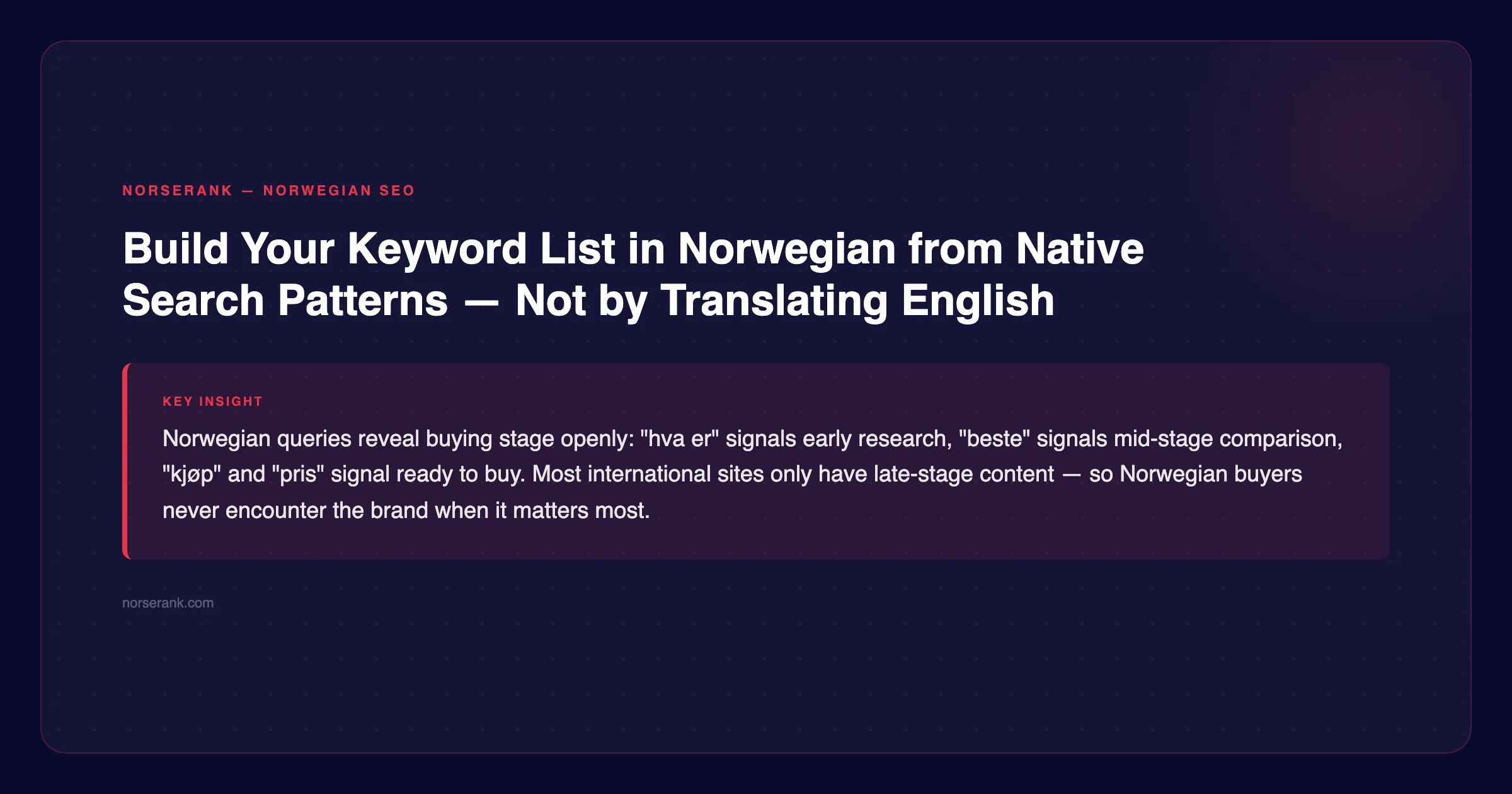
This is the single most underused tactic in international SEO for Norway. Norwegian queries reveal where the searcher is in the buying journey more openly than English ones do.
- Early-stage research: “hva er…”, “hvordan…”, “tips til…”
- Mid-stage comparison: “beste…”, “anmeldelse”, “test”, “vs”
- Late-stage purchase: “pris”, “tilbud”, “leverandør”, “kjøp”, “nær meg”
Most international sites have content for the late stage only, product and service pages with commercial intent. The result is that Norwegian researchers in the early stage never encounter the brand, and competitors capture them with informational content first. By the time the Norwegian buyer is in late-stage comparison mode, the international brand is already off the shortlist.
Build content across all three stages. Especially the first.
Set realistic timeline expectations
The honest answer to “how long does it take to rank in Norway” is: it depends on the keyword competition.
- KD under 10: Two to three months to page one with proper localisation and a few credible links.
- KD 10 to 20: Four to six months with sustained content and steady link velocity.
- KD 20 to 40: Six to twelve months. Realistic only with consistent investment.
- KD above 40: A year or more, and probably not worth the spend for most international companies entering Norway. Compete on long-tail terms and topical authority instead.
Norway is structurally less competitive than the US for English-equivalent keywords. That is the advantage of entering now. It is also why founders who treat Norwegian SEO as a six-month investment rather than a twelve-month one tend to win.
What to do this week
If you are starting cold:
- Decide your domain structure before any content work
- Pull a Norwegian-only keyword list and identify your top five low-competition targets
- Commission one native Norwegian writer to produce the first three pages
- Set up Search Console filtered to Google.no
- Identify two Norwegian publications relevant to your sector and pitch a single placement
If your site is already live and not ranking, the first audit question is almost always “is the content actually Norwegian, or is it translated?” Eight times out of ten, that is the answer.
Where this fits
Ranking in Norway is not a separate skill from international SEO. It is international SEO done with native Norwegian craft underneath. The buyers who win in this market are the ones who treat Norway as a market to be earned, not a country page to be filled.
If you want the full version of this playbook applied to your sector, the 2026 Norwegian SEO Blueprint covers domain choice, keyword strategy, link sources, and reporting in detail.