How to Earn Norwegian Backlinks That Actually Move Google.no Rankings

Backlinks remain one of the strongest ranking factors on Google.no, and the gap between Norwegian and international links is wider than most international agencies acknowledge. A single editorial mention in DN or E24 will do more for your Norwegian rankings than fifty link exchanges from generic sites in your home market.
The catch is that Norwegian backlinks are also harder to fake. Google.no has tightened on low-quality patterns over the last two years. The agencies still selling Norwegian “link packages” are mostly selling devalued links that no longer move rankings. This post walks through which sources actually count, how to earn them, and what to avoid.
Why Norwegian backlinks matter more on Google.no

Google’s local relevance signals have always weighted country-level authority differently than global authority. On Google.no, this gap is sharper than on most country versions because Norway is a small, tight market with a clearly defined publishing ecosystem.
Three reasons Norwegian backlinks carry disproportionate weight:
- Geographic relevance signal. A link from a .no domain or a Norwegian publication tells Google that your site is relevant to Norwegian users. This is one of the strongest country-targeting signals available, alongside hreflang and a .no domain itself.
- Smaller link graph means each link matters more. Norway has fewer total websites than most major markets. The ratio of credible-to-spam links is more visible to Google’s algorithms, and clean Norwegian backlink profiles are easier to identify and reward.
- Editorial culture is stricter. Norwegian publications have not commercialised their link policies as aggressively as some international media. A link from a Norwegian editorial source is more likely to be a genuine editorial endorsement, which Google treats accordingly.
If you are working out the basics of geo-targeting first, see how to rank in Norway: a practical guide for international founders. Backlinks come after the structural setup is right.
What works: Norwegian backlink sources that move rankings
Five categories of Norwegian links that consistently produce ranking movement:
1. Tier-one business and sector publications
- DN (Dagens Næringsliv). Norway’s leading business daily
- E24. Online business and finance, owned by Schibsted
- Kapital. Business magazine with strong sector authority
- Finansavisen. Financial daily
A single mention or quote in any of these is the gold standard. They carry domain authority above 80, are heavily indexed on Google.no, and signal industry credibility to readers as well as algorithms. Earning one is hard. The path is usually a press release tied to genuine market-entry data, a comment from a senior team member on a sector trend, or a guest column with original analysis.
2. Sector-specific Norwegian trade publications
Every Norwegian sector has its own trade publications. A few examples:
- Bygg.no for construction
- Kampanje for marketing and advertising
- Computerworld Norge for tech
- NHO and LO publications for industry associations
- Helsenytt and Dagens Medisin for healthcare
These have lower domain authority than the tier-one business press but higher topical relevance, which Google.no rewards heavily on commercial searches. A trade publication mention is often easier to earn than a DN piece and can be more valuable for ranking on sector-specific Norwegian keywords.
3. Norwegian university and research domains
- .uio.no (University of Oslo)
- .ntnu.no (Norwegian University of Science and Technology)
- sintef.no (research foundation)
- bi.no (BI Norwegian Business School)
Links from these domains carry significant weight because they signal both Norwegian relevance and editorial credibility. They are hard to earn directly but appear in two practical paths: case studies cited in academic research, and partnerships with university departments on industry data or events.
4. Norwegian trade associations and industry bodies
Most Norwegian industries have at least one association website with respectable authority. Membership is sometimes a route to a directory listing or a member spotlight. The links are not editorial in the strictest sense, but Google.no treats sector association mentions as legitimate trust signals.
5. Local newsroom coverage tied to a regional angle
If your business has a physical or fulfilment presence in any Norwegian region, local newspapers and online news outlets are an underused link source. A piece in Bergens Tidende, Adresseavisen, Stavanger Aftenblad, or any regional paper carries strong local authority and genuine editorial trust.
What does not work: Norwegian link patterns to avoid
Several patterns are still actively marketed in this space and have been devalued or penalised by Google.no:
- Low-quality Norwegian guest posts. Generic blogs that sell guest post placements have largely been devalued. The few that retain authority are rarely the ones taking paid placements.
- Link exchanges with unrelated Norwegian sites. Even if the partner site is Norwegian, an unrelated topical context flags as manipulation.
- Generic Norwegian directories without editorial review. Most have been algorithmically devalued. A few specific ones (Gulesider, Proff, 1881) still matter for local SEO but should not be treated as backlink strategy.
- Bulk Norwegian PBN links. Private blog networks targeted at Norway exist and are still being sold. They do not work consistently and carry penalty risk.
The signal across all of these: if a link source is being marketed at scale and aimed primarily at international buyers entering Norway, it is almost certainly devalued or risky.
How to earn your first three Norwegian backlinks
If you are starting from zero, the practical sequence:
- Identify two sector publications and one tier-one business publication. Look at who is being quoted in pieces about your industry. Note the journalists and editors.
- Build a single piece of original Norwegian-relevant data or perspective. This could be a market-entry analysis, a benchmark, or a contrarian take on a sector trend. The bar is “publishable insight,” not “press release.”
- Pitch one publication at a time. Email the journalist or editor with the angle, the data, and a clear ask. Norwegian journalists respond at meaningful rates to genuine industry pitches, especially from international companies entering the market with a fresh perspective.
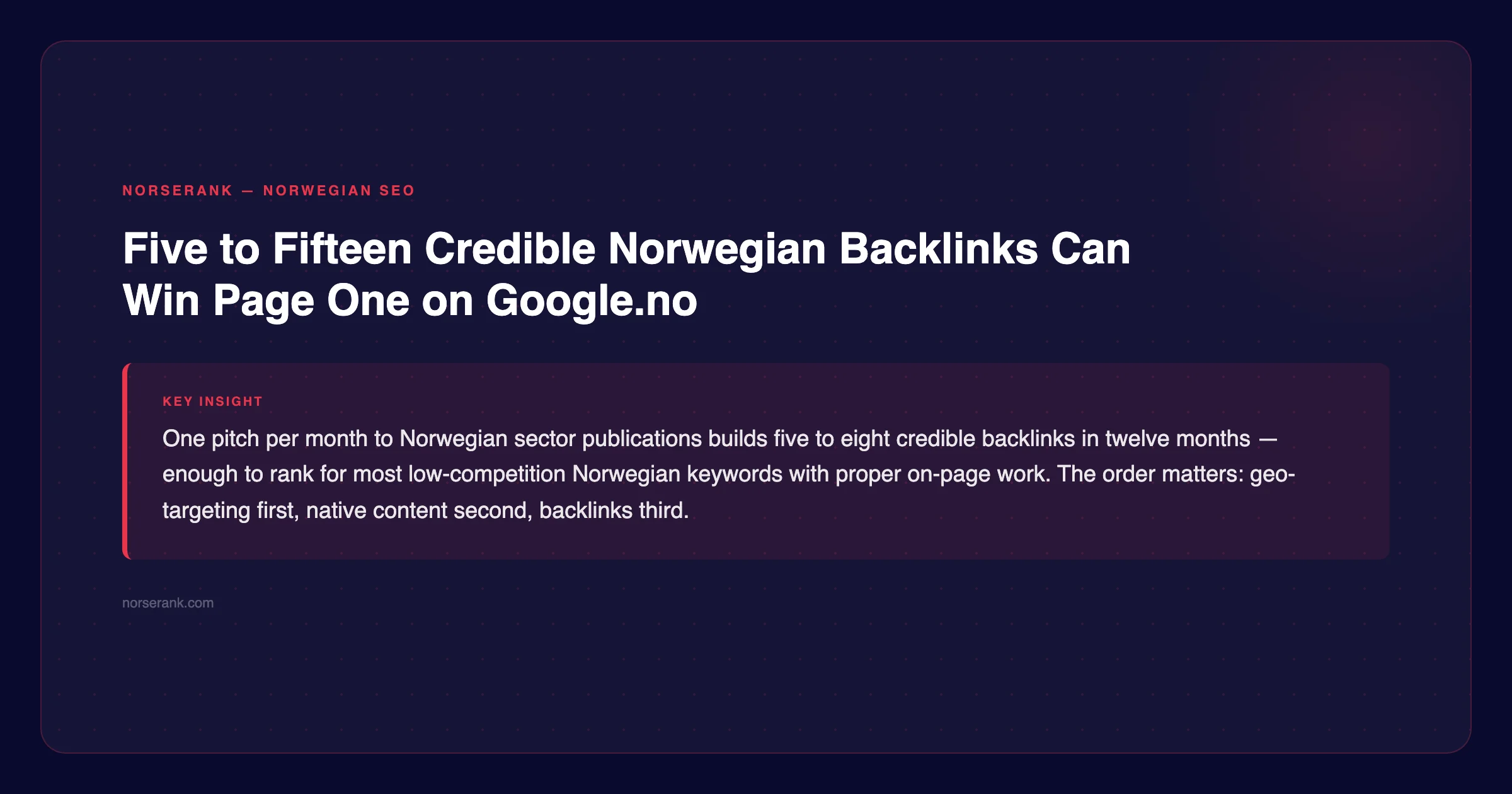
The timeline for the first link is usually four to eight weeks if the pitch is strong. Build a habit of one pitch per month and you will have five to eight Norwegian backlinks within twelve months, which is enough to rank for most low-competition Norwegian keywords with proper on-page work.
Where Norwegian backlinks fit in the larger ranking picture
Backlinks are necessary but not sufficient for Norwegian SEO. Without native content, hreflang correctly set, and Search Console filtered to Google.no, even a strong backlink profile will underperform. The order matters: structural geo-targeting first, native Norwegian content second, backlinks third.
For the full sequence applied to your sector, the 2026 Norwegian SEO Blueprint covers domain choice, content strategy, link sources, and milestone tracking in one document. It is the version of this post applied to a real ninety-day plan.
If you have already started link-building and the rankings are not moving, the diagnostic question is usually about content, not links. We covered that case in hiring a Norwegian SEO consultant: what to look for, specifically the section on how native content production differs from translated content.