SEO Tips for Norway: 7 Things That Actually Move Rankings on Google.no

Most SEO tips for Norway are just translated American advice. Tactics that work on Google.com but ignore how Norwegians actually search, which directories Google.no actually reads, and how buyer intent shows up in Norwegian. This piece pulls together seven things that move Norway SEO rankings specifically, drawn from work with Norwegian and international companies that want to be found by Norwegian buyers.
One premise first. Google.no and Google.com are two different ranking environments. Strong international rankings tell you very little about how you’ll perform on Norwegian queries. Local work is required.
1. Write in Norwegian, not translated English
The most common mistake international companies make is running English content through Google Translate or DeepL and shipping it. The output is grammatically correct, but dead.
Norwegian keywords often carry different intent than their English equivalents. “SEO consultant” usually has a B2B agency buyer in mind. SEO-konsulent (the Norwegian equivalent) is more often searched by small business owners who want to do the work themselves. Two different buyers, two different offers, two different pages.
Write directly in Norwegian. Have a native speaker read it aloud before you publish. If it sounds like a translation, it is one, and Google.no treats it that way.
Of all the Norway SEO tips on this list, this is the most underrated. Norwegian content written by a Norwegian beats translated English every time.
2. Understand what makes Google.no different from Google.com
Google.no weighs Norwegian language signals, .no domains, and Norwegian local relevance more heavily than Google.com does. A US site with strong domain authority can still be invisible on Google.no because it lacks the Norwegian signals the algorithm is looking for.
Two practical consequences. Set up a separate Search Console property filtered to Google.no. Never trust mixed data. And configure proper geo-targeting through hreflang or a .no domain if Norway is a real target market, not a bonus.
3. Build links from Norwegian sources that actually count
Norwegian backlinks count for more than international ones on Norwegian SERPs. But not every Norwegian link carries the same weight.
These work:
- Trade publications like DN, E24, Kapital, and Finansavisen
- University and research institution domains (.uio.no, .ntnu.no, sintef.no)
- Established Norwegian industry associations
- Local news outlets, if you have a regional presence
These work poorly or not at all: paid guest posts on low-quality blogs, generic directories with no editorial control, link swaps with unrelated Norwegian sites. Google.no has tightened up on this over the last few years.
4. Use local directories that Google actually reads
Here’s the list that matters for Norwegian businesses:
- Gulesider (gulesider.no) is still the most important Norwegian business directory for SEO purposes
- Proff (proff.no) provides directory history plus company information Google reads
- 1881 (1881.no) is broadly indexed and gives solid local authority
- Trade directories (bransjekataloger) for your sector — for example Bygg.no for construction or Helsenorge for healthcare
The point isn’t volume. It’s consistency. Your company name, address, and phone number have to be identical across every source. Discrepancies confuse Google and weaken local rankings.
5. Use schema markup correctly for Norwegian pages
Schema.org markup works the same way in Norway as everywhere else, but a few types are particularly important for Norwegian businesses:
- LocalBusiness with Norwegian address format and opening hours in 24-hour time
- Organization with the organisasjonsnummer (company registration number from Brønnøysund)
- Product and Offer with prices in NOK
- FAQPage with questions phrased the way Norwegians actually ask them
Hreflang is only relevant if you run multiple language versions. If your site is Norwegian-only, skip hreflang and rely on clear geo-targeting through a .no domain or Search Console settings.
6. Read buyer intent in the Norwegian language
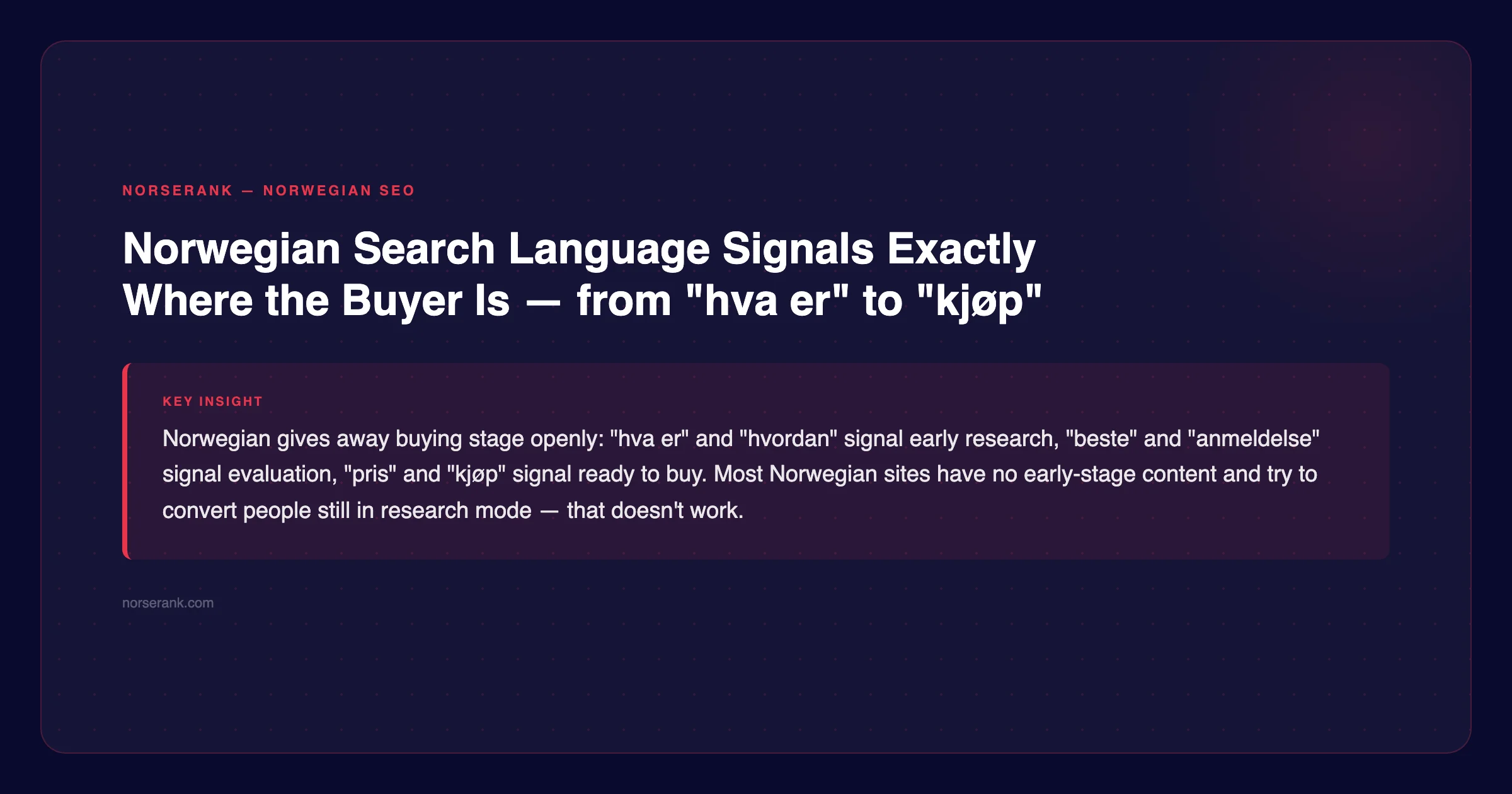
Norwegian gives away where someone is in the buying journey, if you know the signals.
Early stage, information-seeking:
- hva er… (“what is…”), hvordan… (“how…”), forskjell mellom… (“difference between…”)
- tips, guide, veiledning (guide)
Mid-stage, evaluation:
- beste… (“best…”), anbefale… (“recommend…”), test, anmeldelse (review)
- vs, sammenligning (comparison)
Late stage, ready to buy:
- pris (price), pris norge (price in Norway), tilbud (offer)
- leverandør (supplier), konsulent (consultant), byrå (agency)
- bestill (order), kjøp (buy), nær meg (near me)
Build content for all three stages. Most Norwegian sites have no early-stage content and try to convert people who are still in research mode. That doesn’t work.
This might be the most practical of all the Norway SEO tips here. Norwegian search intent is more open about where the user is in the process than English equivalents often are.
7. Adapt to the Norwegian SERP layout
Norwegian search results look different from American ones. Featured snippets dominate, the local pack with the map appears earlier, and Google often shows direct answers pulled from Norwegian sources before the first organic result.
Three practical moves.
Write definition paragraphs early on the page, ideally 40 to 60 words, formatted so Google can pull them as featured snippets.
Use H2 questions that match how Norwegians actually search. Not “Our service explained” but “Hva koster det?” (“What does it cost?”) or “Hvordan kommer jeg i gang?” (“How do I get started?”).
Make sure LocalBusiness schema is set up correctly if you have a physical address in Norway. The local pack is one of the biggest traffic drivers on Norwegian commercial queries, and without proper schema and a Google Business profile you’re not in it.
Summing up
Norway SEO isn’t about doing everything differently from international SEO. It’s about getting the foundation right on Norwegian terms. Write in Norwegian, not translated English. Build authority from Norwegian sources. Understand that Google.no reads different signals than Google.com. Read buyer intent in the language itself.
If this landed, and you’re working out how to build Norwegian visibility in 2026, we’ve packaged the full framework into NorseRank’s Norwegian SEO blueprint. It covers keyword research in Norwegian, directory hygiene, link building from Norwegian sources, and how to measure properly on Google.no.